.png)
Demand Generation: Driving eCommerce Growth Online


Every growing e-commerce brand faces the challenge of moving beyond quick sales towards meaningful, long-term customer engagement. With competition intensifying in the United Kingdom and Ireland, understanding the true power of demand generation becomes vital for sustainable success. This approach does more than spark curiosity, carefully building genuine interest through precise audience targeting, brand relevance, and ongoing relationship nurturing. Discover how reframing demand generation can reshape your strategy and support consistent revenue growth.
Table of Contents
Key Takeaways
Point | Details |
Long-term Strategy | Demand generation is a nuanced approach focused on building sustainable customer relationships rather than just immediate sales. |
Audience Targeting | Effective demand generation hinges on precise audience segmentation to create tailored marketing strategies. |
Continuous Learning | Implementing a feedback loop and adapting strategies based on real-time data is crucial for successful demand generation. |
Technological Integration | Leveraging advanced analytics and technological innovations is essential for enhancing customer engagement and driving growth in e-commerce. |
Demand generation: core definition and misconceptions
Demand generation represents a strategic marketing approach designed to create predictable, sustainable interest in a company’s products or services. Far from being a simple advertising tactic, it is a comprehensive process that transforms how businesses attract and engage potential customers.
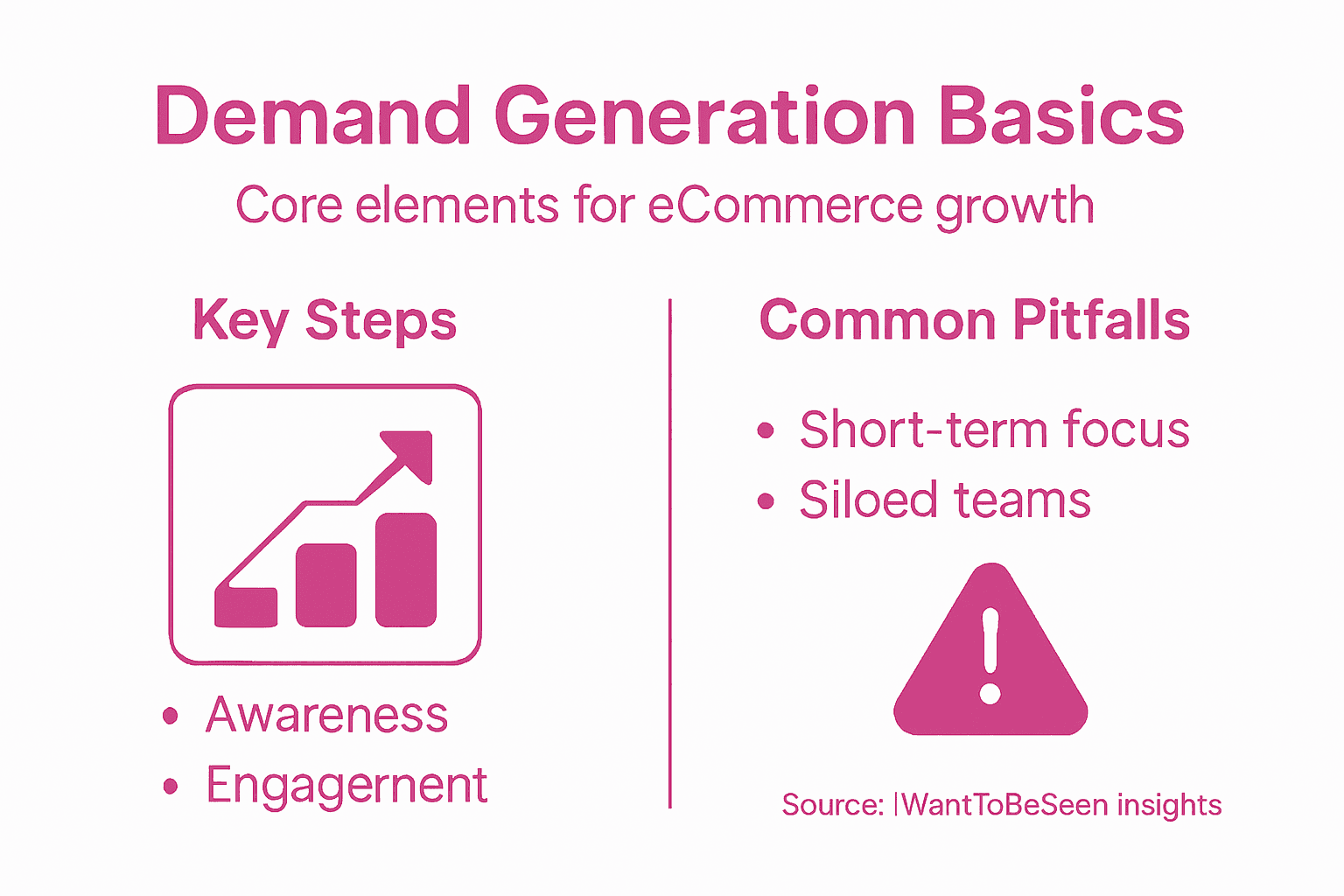
At its core, demand generation focuses on targeted marketing programs that systematically build awareness and cultivate genuine interest. Unlike traditional marketing methods that rely on broad-spectrum campaigns, this approach meticulously maps the customer journey, creating precise touchpoints that resonate with specific audience segments.
Key components of effective demand generation include:
Building initial brand awareness
Positioning product relevance
Providing robust validation support
Strategically mitigating customer evaluation risks
Most e-commerce businesses misunderstand demand generation as a one-time sales push. In reality, it’s a nuanced, long-term strategy focused on nurturing relationships and systematically gauging prospects’ purchasing potential. The goal isn’t just immediate conversion but establishing sustainable engagement that transforms interested parties into loyal customers.
To better understand demand generation, here’s how it differs from traditional marketing approaches:
Aspect | Demand Generation Approach | Traditional Marketing Approach |
Focus | Long-term relationship building | Short-term sales activation |
Audience Targeting | Precise segmentation | Mass market focus |
Measurement | Customer journey analytics | Campaign reach and impressions |
Result Sustainability | Sustainable engagement | Temporary interest |
Demand generation integrates marketing programs with a structured sales process, creating meaningful connections beyond transactional interactions.
Pro tip: Develop a holistic demand generation strategy by mapping your ideal customer’s entire decision-making journey, not just their initial point of contact.
Types of demand generation in eCommerce
E-commerce businesses can leverage multiple sophisticated demand generation approaches to drive customer interest and engagement. These strategies go beyond traditional marketing, creating targeted methods that resonate with specific audience segments and address their unique purchasing motivations.
Demand generation programs involve multiple strategic components that help businesses understand and stimulate market interest. The primary types of demand generation in e-commerce can be categorised into several key approaches:
Content-driven demand generation
Blog posts and educational resources
Video tutorials and webinars
Downloadable guides and whitepapers
Digital advertising demand generation
Targeted social media campaigns
Programmatic advertising
Retargeting strategies
Interactive demand generation
Product recommendation engines
Online quizzes and assessments
Personalised email marketing sequences
These approaches are not mutually exclusive but work synergistically to create a comprehensive demand generation ecosystem. By understanding different consumer behaviours and needs, e-commerce businesses can craft nuanced strategies that transform casual browsers into committed customers.
Effective demand generation requires understanding multiple market dynamics and creating precisely targeted engagement strategies.
Pro tip: Develop a multi-channel demand generation approach that combines different strategies, allowing you to reach potential customers through various touchpoints and interaction modes.
How demand generation works for scaling brands
Scaling brands require a sophisticated approach to attracting and converting potential customers. Modern marketing strategies combine brand awareness with targeted demand generation techniques that create a comprehensive customer engagement ecosystem.
The demand generation process for scaling brands typically involves a strategic multi-stage approach that transforms potential interest into measurable business outcomes. These stages encompass critical components designed to systematically nurture customer relationships:
Awareness Creation
Identifying target audience segments
Developing compelling brand narratives
Establishing initial market positioning
Interest Cultivation
Producing high-value content
Demonstrating unique value propositions
Creating targeted engagement touchpoints
Conversion Optimisation
Implementing personalised marketing strategies
Developing sophisticated lead nurturing workflows
Tracking and analysing customer interaction metrics
Successful demand generation for scaling brands requires an agile, data-driven approach that continuously adapts to evolving customer behaviours and market dynamics. By integrating advanced analytics, businesses can create precise, responsive marketing strategies that efficiently convert potential interest into sustainable revenue streams.
Effective scaling demands a holistic approach that seamlessly connects brand storytelling with strategic demand generation tactics.
Pro tip: Implement a continuous learning model in your demand generation strategy, using real-time data insights to continuously refine and personalise your customer engagement approach.
Benefits, challenges, and common mistakes
Demand generation offers transformative potential for e-commerce businesses, but navigating its complexities requires strategic insight. Marketers consistently encounter nuanced challenges in scaling their demand generation efforts, requiring sophisticated approaches to overcome inherent obstacles.
The key benefits of a robust demand generation strategy include:
Enhanced Customer Understanding
Deeper audience segmentation
More precise targeting capabilities
Improved customer journey mapping
Operational Advantages
Streamlined sales and marketing alignment
More efficient resource allocation
Predictable revenue generation
Strategic Marketing Improvements
Increased brand visibility
Higher quality lead generation
More meaningful customer interactions
Common mistakes can significantly undermine demand generation effectiveness. E-commerce brands frequently struggle with challenges like inconsistent messaging, poor data integration, and misaligned sales-marketing objectives. These pitfalls often stem from treating demand generation as a transactional process rather than a holistic, relationship-building strategy.

The following table summarises common demand generation challenges and effective solutions:
Common Challenge | Strategic Solution |
Inconsistent messaging | Centralised brand guidelines |
Poor data integration | Unified analytics platform |
Sales-marketing misalignment | Regular cross-team workshops |
Transactional interactions | Lifecycle-focused engagement programs |
Successful demand generation requires a nuanced approach that balances technological sophistication with genuine human connection.
Pro tip: Implement a continuous feedback loop between your sales and marketing teams to rapidly identify and address gaps in your demand generation strategy.
Successful strategies for UK and Irish brands
E-commerce brands in the United Kingdom and Ireland must adopt sophisticated, data-driven strategies to remain competitive in an increasingly complex digital marketplace. UK e-commerce growth demands innovative approaches to digital product narratives, focusing on emerging technological and consumer trends.
Successful strategies for UK and Irish e-commerce brands include:
Digital Transformation Approaches
Implementing AI-driven personalisation
Expanding social commerce capabilities
Developing transparent product storytelling
Consumer Experience Innovations
Creating seamless omnichannel experiences
Prioritising sustainability messaging
Developing interactive product engagement
Technological Integration
Utilising standardised product identifiers
Implementing advanced analytics
Developing adaptive marketing technologies
The most successful UK and Irish brands recognise that modern demand generation transcends traditional marketing approaches. By embracing technological innovation, understanding nuanced consumer behaviours, and creating genuine, value-driven interactions, these brands can differentiate themselves in a saturated digital marketplace.
Strategic demand generation requires a holistic approach that balances technological sophistication with authentic customer connection.
Pro tip: Invest in creating comprehensive, data-driven customer personas that enable hyper-personalised marketing strategies across multiple digital platforms.
Unlock Sustainable eCommerce Growth with Expert Demand Generation Support
The article highlights the challenge many eCommerce brands face when trying to build lasting customer relationships through precise demand generation strategies rather than one-time sales pushes. If you struggle with fragmented marketing efforts, inconsistent messaging or aligning sales and marketing teams, you are not alone. Demand generation requires a holistic, data-driven approach to target the right audience segments, nurture interest across multiple touchpoints and create measurable revenue growth.
At iWantToBeSeen, we combine over 25 years of hands-on experience scaling successful eCommerce brands with advanced digital marketing services specialising in SEO, AI, Social Media and PPC. We understand the importance of creating engaging brand narratives and optimised conversion pathways that mirror the sophisticated demand generation concepts discussed. Our approach helps you overcome common pitfalls by integrating unified analytics, personalised customer journeys and continuous feedback loops ensuring you stay competitive in markets including the United Kingdom and Ireland.
Experience the difference a tailored demand generation strategy can make for your brand.
Ready to transform your demand generation into measurable growth today

Start your journey with iWantToBeSeen and discover proven digital marketing solutions that build sustainable eCommerce success. Visit our landing page to learn more and let us help you build a future-proof customer engagement strategy.
Frequently Asked Questions
What is demand generation in eCommerce?
Demand generation is a strategic marketing approach designed to create sustained interest in a company’s products or services through systematic customer engagement and awareness-building.
How does demand generation differ from traditional marketing?
Demand generation focuses on long-term relationship building and precise audience targeting, while traditional marketing often emphasises short-term sales activation with a broader audience approach.
What are key components of a successful demand generation strategy?
Key components include building brand awareness, positioning product relevance, providing robust validation support, and mitigating customer evaluation risks throughout the customer journey.
Why is it important for brands to integrate demand generation into their marketing strategy?
Integrating demand generation helps brands enhance customer understanding, streamline operations across sales and marketing, and create more meaningful customer interactions, ultimately leading to predictable revenue generation.
Recommended
Comments