.png)
Customer loyalty programmes explained: Increase sales


TL;DR:
Many UK and Irish e-commerce brands mistake repeat purchases for genuine customer loyalty, which requires deliberate strategy. Effective loyalty programmes, built on clear mechanics and seamless communication, nurture true brand preference and long-term engagement. Measuring success through repeat purchase rates, CLV, and redemption levels over time ensures authentic growth beyond initial enrolment figures.
Repeat purchases feel great, but they don’t always mean you’ve earned loyalty. Many UK and Irish e-commerce owners conflate a customer buying twice with a customer who actually prefers their brand. There’s a crucial difference. A structured rewards system designed to encourage repeat patronage can build genuine preference over time, but only when designed with that goal in mind. This guide breaks down what loyalty programmes really are, how their mechanics work, which models suit different business types, and where most brands go wrong before they see results.
Table of Contents
Key Takeaways
Point | Details |
Loyalty is more than points | True loyalty programmes encourage repeat custom and brand preference, not just transactions. |
Simple mechanics work best | Smooth enrolment and clear rewards increase participation and satisfaction. |
Measure what matters | Focus on repeat purchase rate and customer lifetime value, not just sign-ups. |
Beware of drastic changes | Changing reward rules can cause the best customers to leave your programme. |
Hybrid models increase flexibility | Combining approaches helps adapt to customer behaviour and business needs. |
What is a customer loyalty programme?
A customer loyalty programme is far more than a digital stamp card. At its core, it is a structured rewards and benefits system run by a retailer or brand to encourage repeat patronage and higher spend over time. The key word there is structured. An ad hoc discount here and there doesn’t qualify. A loyalty programme has defined rules, consistent mechanics, and measurable outcomes.
The distinction between repeat purchase and actual loyalty matters enormously for your strategy. A customer who returns only when you run a sale is responding to price, not preference. True loyalty means they choose you over competitors even when your price isn’t the lowest. That kind of building customer loyalty takes sustained effort, but the commercial payoff is significant.
For e-commerce businesses specifically, loyalty programmes offer several concrete advantages:
Lower acquisition costs by increasing the lifetime value of existing customers
Improved data collection through programme enrolment, enabling more targeted marketing
Higher average order values when tier structures reward bigger spend
Word-of-mouth referrals from genuinely engaged members who feel valued
Competitive differentiation in crowded categories where product parity is high
The most common reward types you’ll encounter are points accumulation, tiered status levels, cash-back or store credit, and exclusive perks such as early access or free shipping. Each structure creates different behavioural incentives, and choosing the right one for your audience is where the strategic thinking begins.
The bottom line: A loyalty programme isn’t a retention magic wand. It’s a systematic way to make your best customers feel recognised, which is what keeps them coming back without requiring a discount every time.
Core mechanics: How loyalty programmes work
Understanding what a loyalty programme is, the next step is grasping the mechanics behind effective schemes. The operational reality is more involved than most business owners anticipate when they first consider launching one.
Common loyalty programme mechanics include four core stages: customer enrolment, an earning mechanism (whether points, credits, or tier advancement), redemption of earned value, and ongoing communication. Each stage is a potential drop-off point if not executed well.
Here’s how a well-run programme lifecycle looks in practice:
Enrolment: Make sign-up frictionless. A checkout-page prompt, a single-click social login, or a post-purchase email invite all lower the barrier to joining. Complicated forms kill conversion before the relationship starts.
Earning: Define clear rules for how customers accumulate rewards. Points per pound spent, bonus points for reviews or referrals, and tier bonuses for reaching spend thresholds are all proven earning mechanisms.
Redeeming: Make redemption simple and visible. If a customer can’t easily see how to spend their points, they disengage. Redemption needs to feel like a genuine reward, not a puzzle.
Communicating: Regular, personalised updates on points balances, tier progress, and expiry dates keep members active. Without communication, even the best programme goes dormant in customers’ minds.
Integration across channels is non-negotiable for modern e-commerce. Your omnichannel loyalty strategy should ensure that a customer earning points through your website also sees those points reflected in your app, in your email notifications, and at any physical touchpoint you operate. Disconnected systems create frustrating experiences that erode trust.
Programme stage | Key success factor | Common failure |
Enrolment | Frictionless sign-up flow | Too many required fields |
Earning | Clear, predictable rules | Confusing multipliers |
Redemption | Easy, visible, rewarding | Buried in account settings |
Communication | Timely, personalised | Generic broadcast emails |
The customer experience management aspect of a loyalty programme is often underestimated. Every touchpoint where a customer earns or redeems a reward is a moment that shapes how they feel about your brand.
Pro Tip: Trigger an instant on-screen confirmation whenever a customer earns points, whether at checkout, after a review, or on a referral. Immediate positive feedback strengthens the behavioural loop and increases programme engagement significantly.
Popular loyalty programme models for e-commerce
With the basics of programme design in mind, let’s compare the main loyalty models you can choose from. There is no single best model. The right structure depends on your product category, average order frequency, customer demographics, and what your competitors are already doing.
E-commerce loyalty programmes are typically built around points, tiers, paid or subscription access, cash-back or store credit, value-based behaviours, or hybrid combinations of these approaches. Many leading brands use hybrids precisely because single-model programmes plateau quickly.
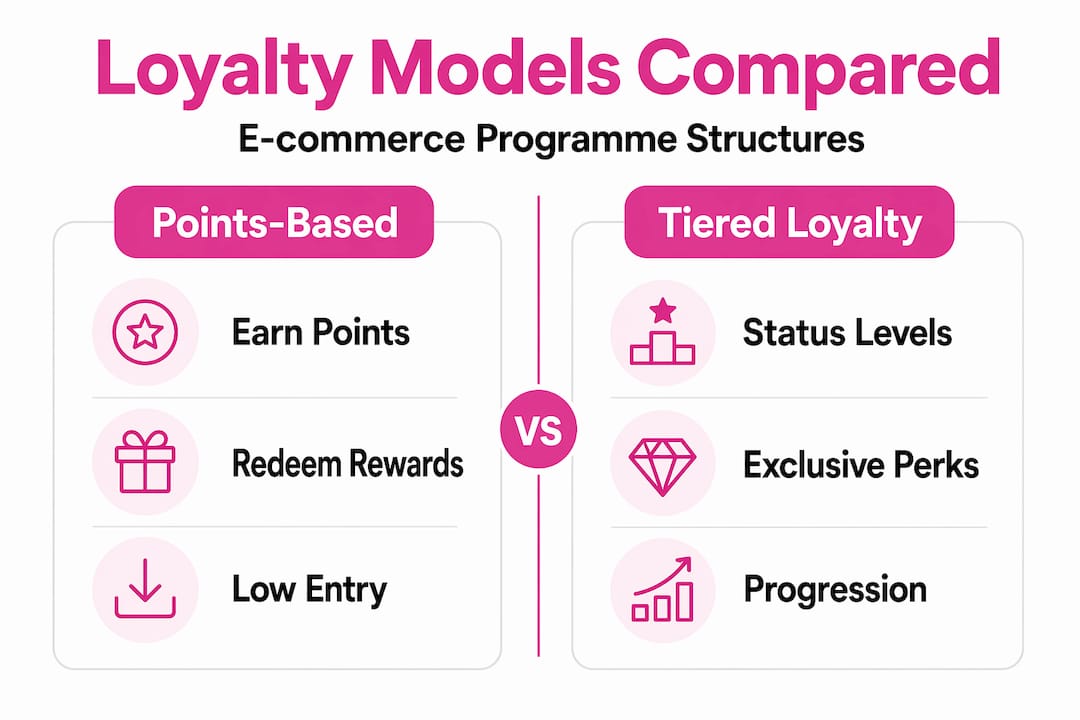
Model | Best for | Key strength | Key weakness |
Points | High frequency, low AOV | Simple and universally understood | Can feel transactional |
Tiers | Mid to high AOV brands | Aspirational motivation | Slow burn for new customers |
Paid/subscription | Premium or niche brands | High commitment, high reward | Requires proven value upfront |
Cash-back/store credit | Price-sensitive segments | Tangible, trusted | Reduces margin if poorly calibrated |
Value-based | Purpose-led brands | Deep emotional connection | Harder to measure ROI |
Hybrid | Most established e-commerce | Flexible and adaptive | More complex to manage |
Here’s how each model plays out in practice for UK and Irish e-commerce operators:
Points programmes work well for fashion, beauty, and everyday consumables where purchase frequency is high enough to accumulate meaningful balances quickly.
Tier programmes suit brands where customers aspire to status, such as travel accessories, premium food and drink, or homeware. Bronze, Silver, and Gold tiers create a ladder that keeps members motivated to spend more.
Paid membership models, similar in structure to what large subscription retailers use, work when the benefits (free delivery, exclusive discounts, early access) clearly outweigh the annual fee.
Cash-back schemes are easy to communicate and resonate strongly with value-conscious shoppers, but you must model the margin impact carefully before launch.
Value-based programmes reward behaviours beyond purchase, such as recycling packaging, writing reviews, or engaging with social content. These suit purpose-led brands targeting millennial and Gen Z audiences.
Boosting customer retention with any of these models depends heavily on aligning the programme structure with your customer lifecycle marketing strategy. A new customer and a VIP customer need very different communications and reward triggers.
Pro Tip: Start with a points-based core, then layer in a tier structure once you have six months of enrolment data. This hybrid approach lets you test mechanics before committing to a complex architecture that’s expensive to change later.
Measuring success: Metrics and what real loyalty looks like
Once you’ve selected a model, it’s vital to know how to evaluate its actual impact. Here is where many e-commerce businesses deceive themselves. High enrolment numbers look impressive in a report, but they tell you almost nothing about whether your programme is actually driving revenue or retention.
Real loyalty measurement should focus on incremental impact metrics rather than sign-up counts alone. The difference between a customer who buys because they’re in your programme and a customer who’d have bought anyway is your programme’s true contribution. Incentive-driven repeat purchases without genuine brand preference are fragile. The moment a competitor offers a better deal, those customers leave.
The metrics that actually matter are:
Repeat purchase rate among enrolled members versus non-members
Customer lifetime value (CLV) for programme participants versus the baseline
Redemption rate as a signal of active engagement, not just passive enrolment
Net Promoter Score (NPS) changes among loyalty members over time
Churn rate comparison between members and non-members
Industry benchmark: Redemption rates between 15% and 25% are considered healthy. If your rate is below 10%, customers are signing up but not engaging. If it’s above 30%, your rewards may be too easy to earn and could be eroding margin.
Patience is also a requirement. Loyalty measurement often needs six to twelve months to produce reliable data on CLV and repeat purchase patterns. Brands that pull the plug after three months because they don’t see dramatic results are abandoning programmes before they’ve had time to prove themselves.
Using behavioural targeting for loyalty allows you to segment members by engagement level and trigger personalised interventions before a customer goes dormant. If someone hasn’t redeemed in 90 days, an automated re-engagement email with a bonus point offer is far cheaper than trying to win them back after they’ve churned.
Pitfalls and best practices for managing loyalty programmes
Finally, understanding what to avoid and how to maintain value is essential for building trust and lasting loyalty. The most common errors are rarely about the programme design itself. They’re about execution, communication, and what happens when something needs to change.
The most damaging mistake is devaluing rewards without adequate warning. Changing programme rules unexpectedly, such as reducing the value of points or removing tier benefits, can cause your most engaged members to feel cheated. Those are exactly the customers you can least afford to alienate. They’re also the ones most likely to share their grievance publicly.
Best practices to follow:
Never change reward values without at least 30 days’ notice and a clear explanation of why
Audit your programme mechanics quarterly to spot earning or redemption anomalies before they escalate
Test the full reward journey from sign-up to redemption on every device and browser type at least twice a year
Keep rules visible by surfacing them on product pages, the basket, and in post-purchase emails
Communicate inactive members with targeted incentives before their points expire
Personalised marketing strategies play a huge role in keeping a loyalty programme feeling relevant rather than generic. Segment your communications by tier, purchase history, and engagement level. A customer who last bought six months ago needs a different message than someone who purchased last week.
Pro Tip: Run a quarterly “mystery perk” for tier members, a small unexpected reward that isn’t listed in the programme rules. This creates genuine delight, reinforces the sense that belonging to your programme is worthwhile, and generates organic social sharing at near-zero cost.
Why genuine loyalty isn’t for sale: A practical perspective
After more than 25 years scaling e-commerce brands, we’ve watched countless loyalty programmes launch with excitement and quietly stagnate within 18 months. The pattern is consistent. A brand invests in a points platform, sends a launch email, and then treats the programme as a set-and-forget retention tool. Enrolment climbs, redemption stays low, and management eventually wonders why CLV hasn’t moved.
The uncomfortable truth is that no amount of points can compensate for a poor product experience, slow delivery, or indifferent customer service. Loyalty programmes amplify what’s already there. If the experience underneath is weak, the programme just accelerates disillusionment among your most engaged customers.
The brands we’ve seen sustain genuine loyalty over years share one trait: they treat the programme as a communication channel, not a discount mechanism. They use it to make members feel genuinely recognised, to share exclusive information first, to ask for feedback and act on it, and to create a community around the brand rather than just a transaction ledger.
Following trends blindly is particularly risky in this space. Gamification mechanics, NFT-based loyalty tokens, and social reward sharing have all had their moment. Some work brilliantly for the right brand and audience. Most are adopted because a competitor tried it, not because the business actually understands its own customer base well enough to know whether it will land.
Ecommerce email campaign strategies remain one of the most effective supporting pillars for any loyalty programme. Not because email is glamorous, but because it’s personal, measurable, and direct. A well-timed email to a loyalty member with a personalised offer based on their purchase history outperforms a generic promotion to your entire list every single time.
The most effective loyalty programme we’ve ever seen in action had modest technology behind it. What it had in abundance was genuine attentiveness: handwritten thank-you notes to top-tier members, early access to genuinely limited products, and customer service agents who could see a member’s tier status and respond accordingly. Those elements cost more time than money, but they created the kind of emotional connection that no competitor discount could dislodge.
Ready to boost retention? Next steps for your business
Understanding loyalty programme theory is valuable, but implementation is where most e-commerce businesses stall. Choosing the right model, integrating it across your channels, and measuring it properly requires both strategic clarity and technical execution.

We’ve spent over 25 years building and scaling e-commerce brands, and we understand how loyalty programmes fit within a broader e-commerce growth strategy. From SEO and email marketing to paid acquisition and AI-driven personalisation, our team helps UK and Irish online retailers build retention systems that actually move the CLV needle. If you’re ready to turn your customer base into a genuine community that buys consistently and advocates loudly, we’d love to show you how.
Frequently asked questions
What makes a customer loyalty programme effective?
Clear rewards, easy enrolment, and ongoing engagement across channels drive true effectiveness. Frictionless enrolment and simple earning rules integrated across all customer touchpoints are the foundation of any high-performing programme.
How quickly do loyalty programmes improve customer retention?
Meaningful results typically take time to materialise. Reliable CLV and repeat purchase data generally requires six to twelve months of programme operation before drawing firm conclusions.
What is a healthy redemption rate for loyalty rewards?
Industry guidance points to 15–25% as a healthy range for active redemption. Rates below this suggest members are joining but not engaging with the programme.
Can changing rewards or points create backlash?
Absolutely. Unexpectedly devaluing points is perceived as breaking a promise, and your most engaged members are the most likely to react negatively and potentially churn.
Is it possible to boost loyalty sign-ups quickly?
Yes. Streamlined sign-up flows such as QR codes and in-app registration can make a rapid difference. Chipotle’s loyalty programme saw daily enrolments increase by approximately 25% after introducing in-restaurant and QR-based sign-up options.
Recommended
Comments